When two sections of pipe need to be joined together for welding, proper alignment is critical. Even a small amount of misalignment can create welding problems, increase rework, and affect the quality of the finished pipeline.
Pipe line-up clamps are designed to help contractors accurately align pipe ends before welding. However, not all line-up clamps work the same way. The two main categories are internal pipe line-up clamps and external pipe line-up clamps.
Understanding the differences between these two types of pipeline equipment can help contractors choose the right tool for their application.
What Is a Pipe Line-Up Clamp?
A pipe line-up clamp is a piece of pipeline welding equipment used to hold two pipe sections in alignment during the fit-up process.
The clamp helps control the position of the pipe ends while the welder completes the root pass or tack welds. Depending on the type of clamp, alignment can be controlled from either inside or outside the pipe.
Proper pipe alignment helps reduce hi-lo, maintain a consistent root gap, and create better conditions for welding.
What Is an External Pipe Line-Up Clamp?
An external line-up clamp fits around the outside of the pipe. It uses shoes, chains, or other components to hold the two pipe sections in position.
External clamps are widely used in pipeline construction because they are relatively simple to install and can provide excellent alignment during field welding.
One of the major advantages of an external clamp is accessibility. Since the equipment remains outside the pipe, there is no need to insert equipment into the pipe bore.
Advantages of External Line-Up Clamps
External pipe line-up clamps can offer several benefits:
- Easy installation and removal
- No equipment inside the pipe
- Suitable for many field welding applications
- Available for a wide range of pipe diameters
- Simple operation and maintenance
External clamps are particularly useful when the pipe configuration, diameter, or jobsite conditions make internal equipment impractical.
What Is an Internal Pipe Line-Up Clamp?
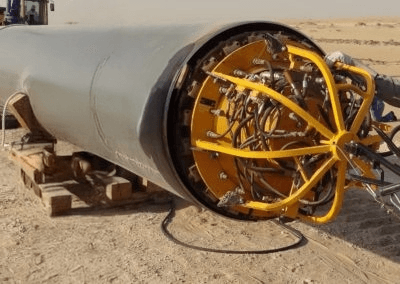
An internal line-up clamp operates from inside the pipe. The clamp expands outward against the internal pipe wall, aligning the two pipe ends from the inside.
Internal clamps are commonly used on larger pipeline construction projects where production speed and precise alignment are important.
Because the equipment works from inside the pipe, the outside of the joint remains accessible to the welding crew.
Advantages of Internal Line-Up Clamps
Internal line-up clamps can provide several advantages:
- Precise pipe alignment
- Improved access around the outside of the joint
- Efficient fit-up on large-diameter pipelines
- Reduced external obstruction during welding
- Excellent repeatability on production welding projects
Depending on the design, internal clamps may be powered hydraulically, pneumatically, or mechanically.
Internal vs. External Line-Up Clamps
The best choice depends on the pipe, project requirements, and welding process.
| Feature | Internal Clamp | External Clamp |
|---|---|---|
| Location | Inside the pipe | Outside the pipe |
| Installation | Installed inside pipe bore | Installed around pipe |
| Outside access | Excellent | More restricted |
| Typical application | Large pipeline projects | Field and fabrication applications |
| Alignment | Highly precise | Highly effective |
| Mobility | Requires access to pipe interior | Easy external access |
| Setup | Can be more involved | Generally straightforward |
Neither design is universally better. The correct choice depends on the application.
When Should You Use an Internal Line-Up Clamp?
Internal clamps are often preferred for large-diameter pipeline construction where production efficiency and accurate alignment are priorities.
They can be especially useful when the welding crew needs unobstructed access around the outside circumference of the pipe.
Internal clamps may also be a good choice for projects involving repeated welds of the same pipe diameter because consistent setup can improve overall productivity.
When Should You Use an External Line-Up Clamp?
External clamps are a versatile option for many pipeline and fabrication applications.
They can be particularly useful when:
- Internal pipe access is limited
- Pipe diameters are smaller
- The job requires frequent clamp repositioning
- The project involves repairs or tie-ins
- A simple and portable alignment solution is preferred
Why Proper Pipe Alignment Matters
Regardless of which type of line-up clamp is used, the objective is the same: achieve accurate pipe fit-up before welding.
Poor alignment can contribute to:
- Hi-lo
- Uneven root gaps
- Incomplete penetration
- Increased welding time
- Additional grinding and rework
- Welding defects
A quality line-up clamp is therefore an important part of the pipe welding process.
Choosing the Right Pipe Line-Up Clamp
When selecting a line-up clamp, consider the pipe diameter, wall thickness, welding procedure, jobsite conditions, and production requirements.
The clamp should be properly sized for the pipe and maintained according to the manufacturer’s recommendations. Worn shoes, damaged components, or improper setup can affect alignment accuracy.
For contractors working across multiple pipe sizes, having the appropriate line-up equipment available can help reduce setup time and keep welding operations moving.
Final Thoughts
Both internal and external pipe line-up clamps play an important role in pipeline construction. Internal clamps provide excellent alignment and outside access for high-production welding, while external clamps offer versatility and straightforward setup for a wide range of applications.
The right pipeline equipment ultimately depends on the specific project. By selecting the appropriate line-up clamp and using proper fit-up procedures, contractors can improve weld consistency, reduce rework, and keep pipeline construction moving efficiently.
 English
  Spanish
  French