
What Are Casing Spacers?
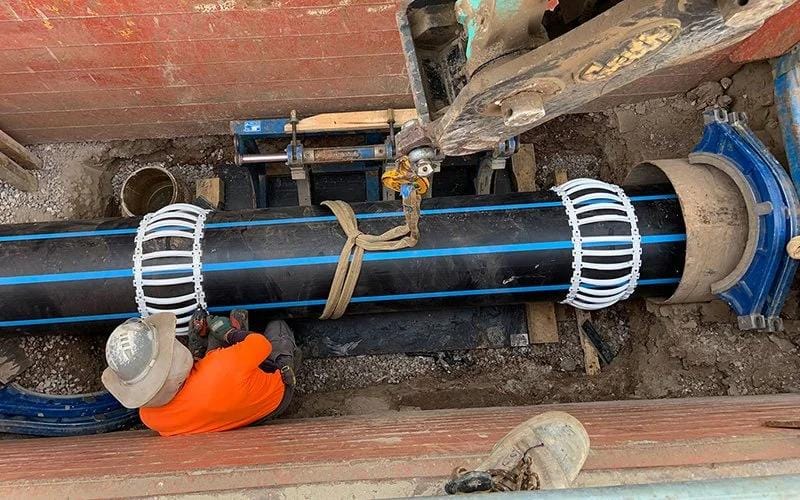
Casing spacers are devices installed around a carrier pipe to keep it centered inside a larger casing pipe. They are commonly used where pipelines pass beneath roads, railways, waterways, or other areas requiring a protective casing.
The carrier pipe transports the product, while the outer casing provides an additional protective structure around it. The space between the two pipes creates an annular gap, and casing spacers help maintain the separation needed for the installation.
Without proper spacing, the carrier pipe may rest against the casing wall during installation or operation. This can damage the external pipe coating, create unwanted contact between the pipes, and complicate installation.
Casing spacers are therefore an important component of certain pipeline installations, helping support the carrier pipe and maintain its position inside the casing.
How Do Pipeline Casing Spacers Work?
Casing spacers are typically attached around the outside of the carrier pipe at calculated intervals. Their runners or support surfaces contact the inside of the casing, allowing the carrier pipe to remain centered as it is pushed or pulled into position.
The spacer design provides clearance between the two pipes and helps reduce direct contact during installation.
Many casing spacer systems also provide electrical isolation between the carrier pipe and casing. This is particularly important in applications where electrical contact could interfere with the pipeline’s corrosion protection strategy.
The number and spacing of the units depend on factors such as pipe dimensions, weight, casing length, installation method, and manufacturer recommendations. Spacers must be positioned to support the installation loads without creating excessive stress on individual units.
Common Types of Casing Spacers
Different casing spacer designs are available for different installation conditions and project requirements.
Steel Casing Spacers
Steel casing spacers use metal components to provide structural support around the carrier pipe. They may be selected for applications with demanding loading requirements, depending on their design and protective features.
Because metallic components can introduce electrical continuity or create coating-damage risks if they contact the carrier pipe, the design must provide suitable isolation and protection.
Plastic and Polymer Casing Spacers
Plastic and polymer spacers are commonly used where electrical isolation and resistance to corrosion are important considerations.
These designs generally use nonmetallic components to separate the carrier pipe from the casing. Depending on the product, they may feature molded segments, runners, and fastening systems designed for specific pipe sizes and loading conditions.
Their suitability depends on the mechanical loads, environmental conditions, and installation requirements.
Modular Casing Spacers
Modular designs consist of multiple segments assembled around the carrier pipe. This arrangement allows the spacer to accommodate different pipe diameters within the manufacturer’s specified range.
Modular systems can simplify handling and installation, especially when working with different pipe sizes or projects requiring multiple spacer configurations.
Not all modular spacers have the same load capacity or runner design, so the manufacturer’s sizing and installation information should always be reviewed.
Casing Spacers vs. Pipe Centralizers
The terms casing spacer and pipe centralizer are sometimes used interchangeably, but their intended applications can differ.
Casing spacers are specifically designed to position a carrier pipe inside an outer casing. They commonly include runners that help the pipe move through the casing during installation.
Centralizers can refer to a broader range of devices used to maintain the position of a pipe within another structure or opening.
When selecting equipment, it is important to confirm that the product is designed for the particular casing installation rather than relying only on the terminology used to describe it.
How to Choose the Right Casing Spacer
Selecting the right casing spacer involves more than matching it to the carrier pipe diameter. Several factors should be considered before choosing a product.
Carrier Pipe and Casing Dimensions
The first step is identifying the outside diameter of the carrier pipe and the inside diameter of the casing.
The difference between these dimensions determines the available annular space. The spacer must fit within this space while providing the required clearance and support.
Incorrect sizing can make installation difficult or prevent the carrier pipe from remaining properly centered.
Load Capacity
Casing spacers must support the loads imposed during installation and any other loads considered in the design.
Factors such as carrier pipe weight, contents, length of the casing, installation method, and friction during pulling or pushing can influence spacer selection.
The selected spacer must have adequate load capacity for the intended application. Do not assume that a spacer suitable for a short installation will automatically be appropriate for a longer or heavier carrier pipe.
Runner Design
Runners are the surfaces that contact the inside of the casing. Their design affects how the carrier pipe moves through the casing.
Runner height, shape, material, and arrangement can influence clearance and friction during installation.
The appropriate design depends on the casing condition, installation method, and manufacturer recommendations.
Electrical Isolation
In many pipeline applications, preventing direct electrical contact between the carrier pipe and casing is an important consideration.
A spacer with suitable insulating components can help maintain separation and support the project’s corrosion control strategy.
The spacer material and design should be reviewed to ensure that metallic components do not create unwanted contact with the carrier pipe.
Installation Conditions
Consider how the carrier pipe will be installed. A pipe pulled through a long casing may experience different loading conditions than one pushed through a short casing.
Other considerations include casing alignment, entry conditions, internal obstructions, and available installation equipment.
These factors can influence the number, spacing, and type of spacers required.
Why Are Casing End Seals Important?
Casing end seals are installed at the ends of a casing to close the annular space between the carrier pipe and casing.
They help limit the entry of water, soil, debris, and other external contaminants into the casing. Depending on the design, they may also help manage moisture exposure and protect the annular space.
Casing end seals and casing spacers perform different functions. Spacers position the carrier pipe inside the casing, while end seals close the space at the casing openings.
Both components may be specified as part of the same installation, but their selection should be based on the project’s requirements.
Common Mistakes When Selecting Casing Spacers
Several issues can affect casing spacer performance and installation quality:
- Incorrect sizing: A spacer that does not match the carrier pipe and casing dimensions can create installation problems.
- Insufficient load capacity: The selected design may not support the loads experienced during installation.
- Ignoring electrical isolation: Incompatible materials or exposed metallic components can create unwanted contact between the carrier pipe and casing.
- Incorrect spacing: The number and position of spacers should follow the manufacturer’s recommendations and the project design.
- Overlooking installation conditions: Long casing runs, friction, alignment, and pulling forces can influence the required spacer configuration.
Planning these details before installation can help reduce delays and avoid damage to the carrier pipe coating.
Choosing the Right Pipeline Casing Spacer
Casing spacers help maintain the position of a carrier pipe inside a casing while providing separation and, where required, electrical isolation. Selecting the correct design involves considering pipe dimensions, load requirements, runner configuration, materials, and installation conditions.
Casing end seals can complement the installation by closing the annular space at the casing openings and limiting the entry of external contaminants.
For pipeline contractors and infrastructure projects, choosing compatible components helps support a reliable installation and protect the carrier pipe throughout its service life.
 Spanish
 English
 French