
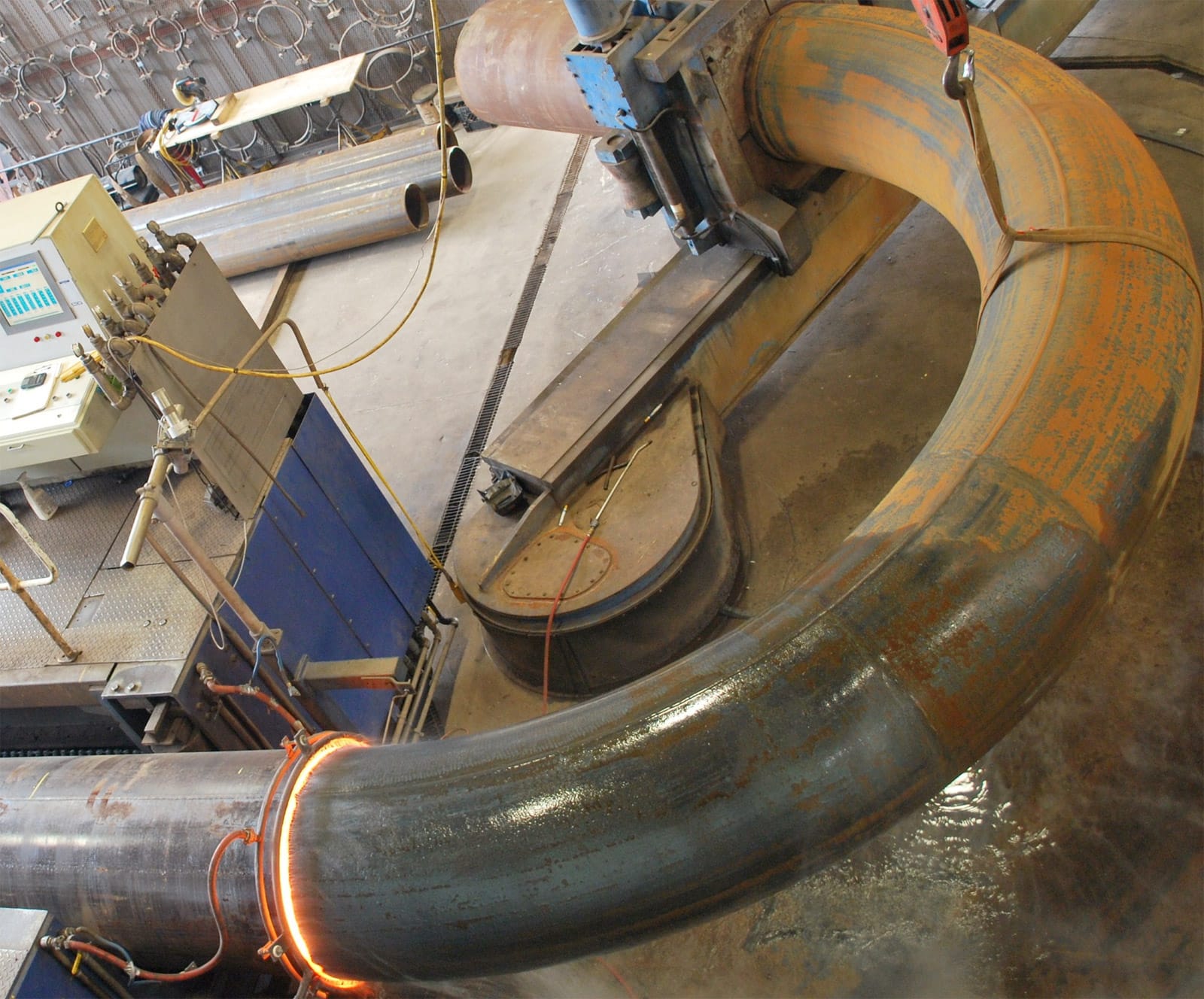
Pipe bending is an essential part of many pipeline construction projects. Pipelines rarely run in a perfectly straight line, so pipe must often be bent to follow changes in terrain, road crossings, river crossings, and other changes in direction. The method used to create those bends can have a significant impact on project efficiency, pipe integrity, and the equipment required.
Two of the most common approaches are cold bending and hot bending. While both methods are used to change the shape of steel pipe, they work in very different ways and are suited to different applications.
Understanding the difference between cold bending and hot bending can help pipeline contractors select the right method and the right pipeline equipment for a project.
What Is Cold Bending?
Cold bending is the process of bending pipe at or near ambient temperature without intentionally heating the steel to make it more flexible.
In pipeline construction, large hydraulic pipe bending machines are commonly used to apply controlled force to the pipe. The pipe is gradually formed into the required bend while remaining below the temperature range associated with hot forming.
Cold bending is particularly common for large-diameter transmission pipelines because it can be performed efficiently in the field. A bending machine can be brought directly to the right-of-way, allowing contractors to make bends as the pipeline progresses.
The process typically involves positioning the pipe in the bending machine and applying hydraulic force through the machine’s bending dies. Depending on the equipment and application, an internal mandrel may also be used to support the inside of the pipe during bending.
What Is Hot Bending?
Hot bending involves heating the pipe to an elevated temperature before or during the bending process. Heating makes the steel more workable, allowing it to be formed into bends that may be difficult or impractical to produce using cold bending.
Hot bending is generally performed in a controlled shop or manufacturing environment rather than directly on the pipeline right-of-way. Specialized equipment heats a section of pipe before forming it to the required radius and angle.
Because temperature plays such an important role, hot bending requires careful control of the heating and cooling process. The properties of the steel can be affected by the thermal cycle, making process control and quality assurance particularly important.
Cold Bending vs. Hot Bending: The Main Difference
The simplest distinction is temperature.
Cold bending forms pipe without intentionally heating it, while hot bending uses controlled heat to make the steel more formable.
However, the differences go beyond temperature. The two methods can vary considerably in terms of equipment, production environment, bend geometry, speed, transportation, and quality-control requirements.
For pipeline construction, cold bending is often advantageous because it allows bends to be produced directly in the field. Hot bending, on the other hand, can provide greater control for certain specialized bends and applications.
Advantages of Cold Pipe Bending
One of the biggest advantages of cold bending is its suitability for field pipeline construction.
A hydraulic pipe bending machine can be transported to the jobsite and used to produce bends as required. This reduces the need to manufacture every bend in advance and transport large quantities of specially bent pipe to the right-of-way.
Cold bending can also be highly efficient when large numbers of relatively consistent bends are required. Modern hydraulic bending machines are designed to apply substantial force while maintaining control over the bending process.
Another important advantage is that cold bending avoids the heating and cooling cycle associated with hot bending. When the bending procedure is properly controlled and performed within the pipe’s allowable limits, contractors can efficiently produce field bends while maintaining the required pipe geometry.
Advantages of Hot Pipe Bending
Hot bending has its own advantages, particularly when a project requires bend geometries or configurations that are difficult to achieve through cold bending.
Heating the steel reduces the force required to form the pipe and allows manufacturers to produce certain bends with relatively tight radii or specialized geometries.
Hot bending can also be performed in a controlled manufacturing environment where temperature, tooling, forming, and inspection can be closely monitored.
This makes hot bending useful for specialized applications, fabricated piping systems, and situations where the required bend cannot be efficiently produced using conventional field bending equipment.
When Is Cold Bending Used in Pipeline Construction?
Cold bending is widely associated with large-diameter pipeline construction because of its ability to produce bends directly in the field.
A pipeline route may encounter gradual changes in elevation, direction, or terrain. Rather than relying exclusively on prefabricated bends, contractors can use field bending equipment to create bends that match actual site conditions.
This flexibility is particularly valuable during construction because the terrain encountered in the field may not always match the original assumptions made during design.
Field bending machines can produce bends at the jobsite while allowing contractors to maintain production as the pipeline moves through the right-of-way.
For projects involving large-diameter pipe, selecting a bending machine with the appropriate capacity and tooling is critical. Pipe diameter, wall thickness, material grade, bend radius, and required bend angle all need to be considered when choosing the appropriate equipment.
When Is Hot Bending Used?
Hot bending is more commonly associated with specialized pipe fabrication and applications where controlled heating provides an advantage.
For example, a project may require a particular bend radius or configuration that is difficult to achieve using cold bending. In these situations, hot forming can provide additional flexibility.
Hot bending can also be useful when producing bends that need to meet specific fabrication requirements before the pipe reaches the jobsite.
The exact application will determine whether hot bending is appropriate, and the process must be controlled carefully to ensure the finished pipe meets the applicable engineering and material requirements.
What About Pipe Wall Thinning and Ovality?
One of the important considerations when bending steel pipe is how the pipe’s shape changes during the process.
As pipe is bent, the outside portion of the bend is placed into tension while the inside portion is placed into compression. This can result in changes to wall thickness and pipe geometry.
Ovalidad is another consideration. Instead of remaining perfectly round, the pipe cross-section can become slightly oval during bending.
These effects are important because excessive deformation can affect the pipe’s ability to meet project requirements.
Cold bending equipment can be designed to control these effects through the use of properly matched dies, bending procedures, and internal support. Internal mandrels can provide additional support inside the pipe during bending and help control deformation.
For this reason, choosing the right combination of pipe bending machine, bending dies, and internal mandrel is an important part of planning a pipeline bending operation.
Which Method Is Better: Cold or Hot Bending?
There isn’t a single answer. The better method depends on the pipe, project, bend requirements, and applicable specifications.
For many transmission pipeline projects, cold bending is the practical choice for field production because it allows contractors to create bends directly on the right-of-way using mobile hydraulic bending equipment.
Hot bending can be the better option when specialized geometries, tighter bends, or controlled fabrication conditions are required.
The important thing is not simply choosing between “hot” and “cold.” Contractors need to consider the complete bending operation, including pipe specifications, required bend radius, equipment capabilities, tooling, internal support, inspection requirements, and the project’s applicable standards.
Choosing the Right Pipe Bending Equipment
Whether a project uses cold bending or hot bending, the equipment must be appropriate for the pipe and the required bend.
For cold field bending, contractors should consider factors such as pipe diameter, wall thickness, material grade, bending capacity, available die sets, and the required bend radius. The bending machine also needs to be properly configured for the pipe being processed.
Internal mandrels can be particularly important when bending larger-diameter pipe. By supporting the inside of the pipe, the mandrel can help control deformation during the bending process.
For contractors working across different pipeline projects, having access to a range of pipeline bending equipment can provide additional flexibility. Equipment availability, transportation, maintenance, and rental options can also play a role in determining the most practical solution for a project.
Cold Bending and Hot Bending: Understanding the Difference
Cold bending and hot bending both have an important place in the pipe fabrication and pipeline construction industry. The primary difference is straightforward: cold bending forms pipe without intentional heating, while hot bending uses heat to make the steel easier to form.
For large pipeline construction projects, cold bending is often particularly valuable because hydraulic bending machines can be deployed directly to the field. Hot bending, meanwhile, remains an important option for specialized applications where controlled heating and forming provide advantages.
Understanding the capabilities and limitations of each method allows contractors and engineers to make better decisions about pipe fabrication and equipos de tubería.
When the right bending method, machine, tooling, and procedures are selected, pipe can be formed efficiently while maintaining the geometry and quality required for the project.
 Spanish
  English
  French