In pipeline construction, small setup errors can turn into expensive rework fast. Two of the most overlooked—but critical—factors in field welding are pipe alignment and pipe spacing. They’re often discussed together, but they solve different problems. Understanding both is key to producing consistent weld quality, reducing fit-up time, and avoiding unnecessary stress on the joint.
What Is Pipe Alignment?
Pipe alignment refers to how well two pipe ends are positioned relative to each other before welding. In simple terms, it’s about ensuring the pipe surfaces match up correctly so the weld joint is smooth and even.
Good alignment means:
- Pipe centerlines are properly matched
- Wall heights are flush (minimal high-low condition)
- The joint is stable and won’t shift during tack or root pass welding
Poor alignment leads to:
- Uneven weld penetration
- Internal flow restrictions
- Increased risk of weld defects such as lack of fusion or undercut
- Extra grinding, rework, or even cut-outs
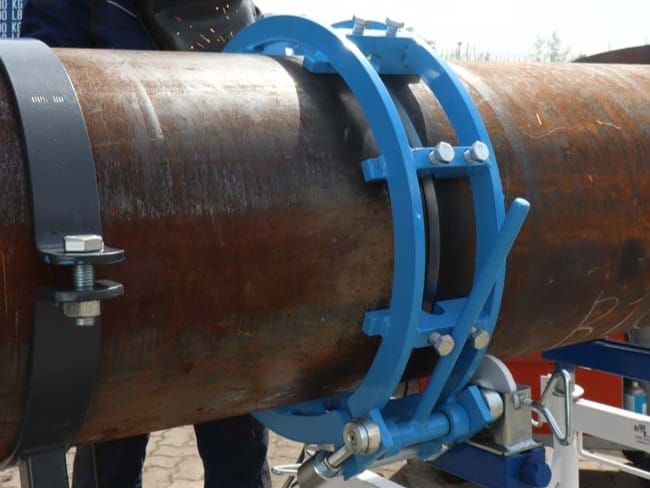
This is where tools like internal line-up clamps and external alignment systems become essential, especially on larger diameter pipe where manual adjustment isn’t practical.
What Is Pipe Spacing (Root Gap)?
Pipe spacing—often called the root gap—is the controlled distance between two pipe ends at the weld joint.
Unlike alignment, spacing is intentional. It’s designed to:
- Allow proper weld penetration during the root pass
- Compensate for thermal expansion during welding
- Ensure consistent weld bead formation on the inside of the pipe
If spacing is too tight:
- The weld may not penetrate fully
- You risk lack of fusion at the root
If spacing is too wide:
- Excess filler material is required
- The weld becomes unstable and harder to control
- There’s a higher chance of burn-through, especially on thinner wall pipe
Correct spacing depends on pipe diameter, wall thickness, welding procedure specification (WPS), and process type.
Why Alignment and Spacing Work Together
One of the most common mistakes in field welding is treating alignment and spacing as the same thing—or focusing on one while ignoring the other.
In reality, they directly affect each other.
For example:
- If alignment is poor, maintaining consistent spacing around the joint becomes nearly impossible
- If spacing is inconsistent, even perfect alignment won’t produce a reliable weld
Think of alignment as the structural setup and spacing as the weld control parameter. You need both to be correct before striking an arc.
How Poor Setup Impacts Field Productivity
When alignment and spacing are not controlled properly, the impact shows up quickly on the jobsite:
- Longer fit-up times due to repeated adjustments
- Increased welder fatigue from fighting inconsistent joints
- Higher rejection rates during inspection
- More rework and grinding, slowing down production
- Inconsistent weld quality, especially on long pipeline runs
In large-scale pipeline projects, even small inefficiencies multiply across hundreds or thousands of joints.
Tools That Improve Alignment and Spacing Accuracy
Field crews rely on specialized equipment to maintain consistency under real-world conditions:
Internal Line-Up Clamps
These are widely used for achieving accurate internal alignment and consistent root gap control. Hydraulic and pneumatic systems are especially useful on larger diameter pipe where manual fit-up isn’t feasible.
External Alignment Clamps
Used when internal access is restricted or for specific weld procedures, these help stabilize pipe ends and maintain joint geometry during tacking.
Pipe Rollers and Cradles
Proper pipe support reduces sagging and movement, which helps maintain both alignment and spacing accuracy during setup and welding.
Beveling Equipment
Accurate bevel geometry is often overlooked, but it directly affects both alignment quality and root spacing consistency.
Best Practices for Field Weld Setup
To improve consistency and reduce rework:
- Always verify alignment before setting root gap
- Use calibrated spacing gauges instead of “visual estimates”
- Ensure pipe support is stable and level before fit-up
- Follow WPS requirements for root gap and tolerance limits
- Re-check alignment after tack welds before proceeding to root pass
Small checks at the start of a weld can prevent major issues later in the process.
Final Thoughts
Pipe alignment and pipe spacing are not interchangeable—they are two separate but equally important parts of a successful field weld setup. Alignment ensures the joint geometry is correct, while spacing ensures the weld itself can be properly formed and inspected.
When both are controlled correctly, crews see:
- Faster fit-up times
- Fewer weld defects
- Reduced rework
- More consistent production output
In pipeline construction, efficiency isn’t just about welding speed—it starts at setup.
 English
  Spanish
  French